

2NI - Neurosciences affectives, Neurocognition et Interactions
Scientific directors : Odile Viltart & Yann Coello
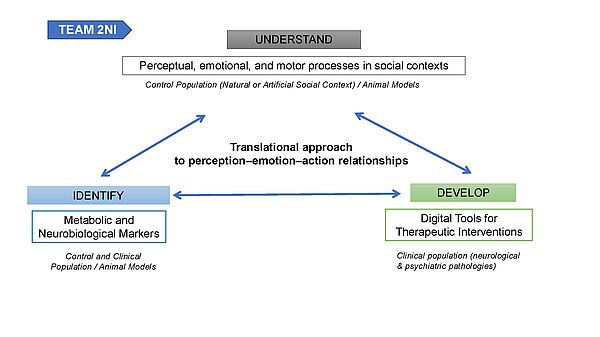
The research themes developed within Team 2NI explore the dynamics of perception–emotion–action relationships in social contexts, at both behavioral and neurophysiological levels. The research investigates the cognitive and affective components of these relationships from fundamental, clinical, and preclinical perspectives, the latter relying in particular on animal models. These components are examined specifically in the context of social interactions or in the presence of emotional and social stimuli, across a variety of environments: natural settings, virtual environments, or artificial setups, including social robotics. Particular attention is paid to the impact of neuropsychological disorders (perceptual and cognitive impairments), psychiatric and neuroaffective disorders (anxiety, depression, multiple sclerosis, and anorexia nervosa) on perception–emotion–action relationships.
The team’s research also aim to pave the way for the development of innovative diagnostic and remediation tools designed to support and treat vulnerable populations, particularly those presenting disorders of perception, emotional regulation, social cognition, or eating behavior.
Targeted Populations:
The team’s research focuse on both neurotypical and clinical populations, including adults and adolescents. Particular attention is also given to human–robot interactions, within the framework of research in social robotics.
Methods Used:
Team 2NI adopts a multidisciplinary approach, combining methods from the behavioral sciences, neuroscience, and advanced digital technologies:
- Behavioral analyses coupled with emerging digital technologies, such as eye tracking, virtual reality, and artificial intelligence;
- Investigation of brain function using neuroimaging and neurophysiological techniques: EEG, functional MRI, and fNIRS;
- Measurement of autonomic nervous system indices, including heart rate variability (HRV), electrodermal activity (EDA), pupil diameter, and facial thermal variations;
- Development of attentional and autonomic remediation procedures, such as biofeedback;
- Use of animal models enabling preclinical exploration of the mechanisms and pathologies under study.
The scientific objectives of Team 2NI are structured around three major axes:
Targeted Populations:
The team’s research focuse on both neurotypical and clinical populations, including adults and adolescents. Particular attention is also given to human–robot interactions, within the framework of research in social robotics.
Methods Used:
Team 2NI adopts a multidisciplinary approach, combining methods from the behavioral sciences, neuroscience, and advanced digital technologies:
- Behavioral analyses coupled with emerging digital technologies, such as eye tracking, virtual reality, and artificial intelligence;
- Investigation of brain function using neuroimaging and neurophysiological techniques: EEG, functional MRI, and fNIRS;
- Measurement of autonomic nervous system indices, including heart rate variability (HRV), electrodermal activity (EDA), pupil diameter, and facial thermal variations;
- Development of attentional and autonomic remediation procedures, such as biofeedback;
- Use of animal models enabling preclinical exploration of the mechanisms and pathologies under study.
Three Research Axes
Axis 1 – “Motor Control and Social Interactions”
This axis focuses on the role of motor processes in human social interactions, as well as on behavioral interactions between humans and robots. It aims to improve understanding of how action contributes to social communication, interpersonal coordination, and emotional regulation. This line of research seeks to identify action parameters that promote effective and socially acceptable exchanges, including in the context of social robotics.
Axis 2 – “Spatial Cognition in Social Contexts”
Research under this axis aims to characterize the relationships between social interactions (cooperation, proximity, threat, affiliation, etc.) and spatial organization in connection with motor behavior, as well as the neurocognitive bases of these relationships. The objective is to better describe the mechanisms through which social factors modulate perception–action coupling in social situations.
Axis 3 – “Vulnerability to Affective Disorders”
This axis brings together clinical and preclinical approaches, including murine models. It aims to better define the neurobiological and neurodynamic mechanisms associated with emotional states and disorders, in interaction with cognitive processes such as attention. It is embedded in a framework focused on understanding and remediating vulnerability factors for affective disorders. The research seeks to link behavioral phenotypes, neurophysiological signatures, and underlying biological mechanisms.
Coordinators : Odile Viltart (Pr) & Yann Coello (Pr)
Researchers: Angela Bartolo (Pr), Yann Coello (Pr), Lucas de Zorzi (MCF), Tatjana Nazir (DR, CNRS), Henrique Sequeira (Pr), Odile Viltart (Pr)
MAST: Sabrina Hassaïni
PhD Students : Laura Boulongne, Clément Brunet, Pierre Csigai, Alice Lagacy, Manon Lenain, Chainez Tahar, Melisa Yavuz